There has been an amendment to the Michigan Earned Sick Time Act (ESTA) in 2025 that directly impacts employers across the state. The law, designed to ensure employees can take necessary sick leave without fear of losing their jobs, has been updated to expand protections and clarify employer obligations. Let our qualified business lawyers in Muskegon, MI, walk you through the key changes introduced and how to implement them for compliance.
- Accrual & Caps: 1-in-30 Rule, 72/40-Hour Limits, and Carry-Over Mechanics
- Who and What Qualifies: Broad “Family Member” Definition and Approved Uses
- HR Compliance Checklist for 2025
- Schedule an ESTA Readiness Audit With Bowen Hoogstra Law
Accrual & Caps: 1-in-30 Rule, 72/40-Hour Limits, and Carry-Over Mechanics
Under the amended Michigan Earned Sick Time Act (ESTA), employees earn one hour of paid sick time for every 30 hours worked. It applies to all eligible employees, including full-time, part-time, and even temporary staff, and the accrual begins on their first day of employment. The amendment, however, sets annual usage caps to help employers manage costs.
Employees may use up to 72 hours of earned sick time per year. For small businesses with 10 or fewer employees, the annual usage cap is 40 hours. But remember, these limits apply to use, not accrual, meaning even if an employee accrues more hours than the cap, that employee can only use up to the specified limit within that year.
Notably, employees may carry over any unused earned sick time from year to year. For instance, if an employee accrues 80 hours in one year and only uses 20 hours, that employee can carry over the unused 60 hours to the following year, although the annual usage caps, depending on the business size, still apply.
As the employer, you have the option to front-load sick time at the start of the year instead of tracking accruals. Front-loading means giving employees a lump sum of sick time at the beginning of the year. If you choose to front-load, you’re not required to carry over unused time, making HR processes more manageable.
Starting February 21, 2025, all Michigan employers must begin accruing sick leave for eligible employees under the updated rules. For small businesses with 10 or fewer employees, a grace period extends until October 1, 2025. Failing to comply can result in penalties, government investigations, and even civil lawsuits.
Who and What Qualifies: Broad “Family Member” Definition and Approved Uses
The amended Earned Sick Time Act (ESTA) outlines specific situations when an eligible employee can use their earned sick time. These include:
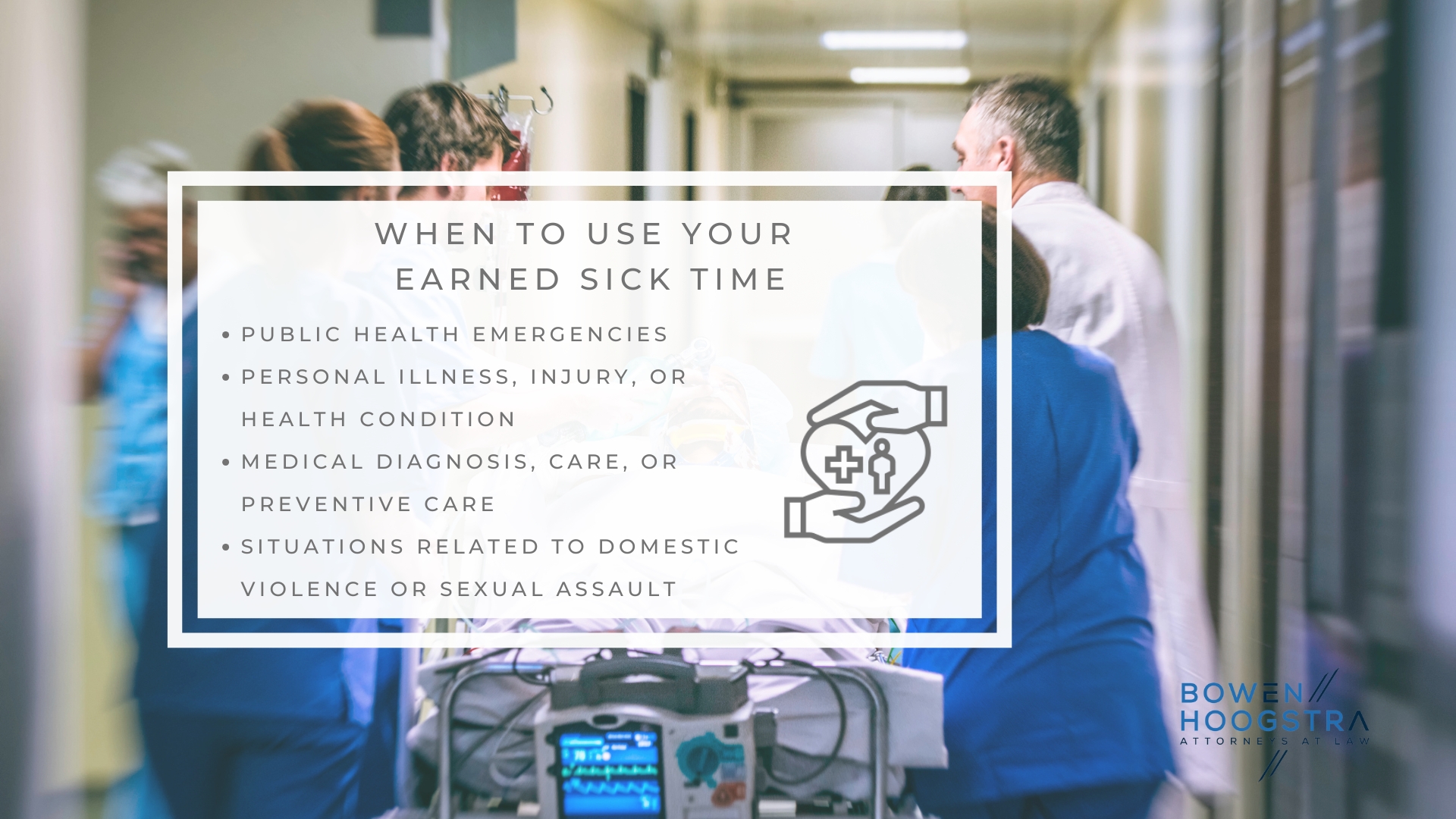
- Public health emergencies. If a business, school, or child care facility is closed by public health authorities, or if an employee or family member is subject to quarantine, earned sick time can be used.
- Personal illness, injury, or health condition. If the employee or a family member is sick, injured, or has a physical or mental health condition, the earned sick time ensures time to recover or seek treatment.
- Medical diagnosis, care, or preventive care. The earned sick time can be used for doctor visits, routine checkups, and preventive health measures, helping reduce the risk of more serious health issues.
- Situations related to domestic violence or sexual assault. Employees can take time off to seek medical care, counseling, legal assistance, or relocate to ensure safety.
Furthermore, the updated ESTA adopts a broad definition of “family member,” aiming to support diverse family structures. A family member may be:
- A grandchild
- A grandparent
- A biological, foster, or adopted sibling
- An individual related by blood to the employee
- An individual whose close association with the employee is the equivalent of a family relationship
- An individual to whom the employee is legally married under the laws of any state, or a domestic partner
- A biological, adopted, or foster child, stepchild, or legal ward, a child of a domestic partner, or a child to whom the employee stands in loco parentis
- A biological parent, foster parent, stepparent, or adoptive parent, or a legal guardian of an employee or an employee’s spouse or domestic partner, or an individual who stood in loco parentis when the employee was a minor child
So, if one of your employees asks for time off to care for an elderly aunt who raised that employee, the request might very well qualify under the new rule. If you’re unsure about a particular situation, it’s best to consult with seasoned business lawyers in Muskegon, MI, to make sure your sick leave policy is compliant and well-defined.
HR Compliance Checklist for 2025
To stay compliant with the amended Earned Sick Time Act (ESTA), employers must make sure their HR policies and procedures align with its requirements, such as:
- Notice
When the need for sick time is foreseeable, the law allows you to require employees to provide at least seven days’ notice. In contrast, if the reason for leave is unforeseeable, such as a sudden illness or emergency, employees should inform you as soon as practicable. Your policy should clearly explain how and when notice must be given.
- Documentation
Employers may require reasonable documentation for absences of more than three consecutive workdays. But the updated ESTA prohibits requests for documentation that would create an undue burden on the employee or disclose unnecessary details about a medical condition.
- Recordkeeping
Employers must maintain records of hours worked, earned sick time accrued, and sick time used for at least three years. These records help prove compliance in case of a complaint or audit. Proper recordkeeping ensures employees have accurate information about their available sick time.
Local business lawyers in Muskegon, MI, can help you build legally sound workplace policies that align with state laws and protect your business in the long run.
Schedule an ESTA Readiness Audit With Bowen Hoogstra Law
With the 2025 deadline quickly approaching, now is the time to review your policies and make sure your business is on track. Waiting until the last minute can expose you to penalties or put you behind your competitors who are already aligning with the updated Michigan Earned Sick Time Act (ESTA) requirements.
Bowen Hoogstra Law is here to guide you through every step of the process. Our competent business lawyers in Muskegon can help review your HR policies and make sure your procedures are both compliant and practical for your team. Contact us today at (231) 726-4484 or here to schedule your ESTA readiness audit.