When you sign a contract, you rely on the written words to define your rights and obligations. But what happens when a dispute arises and the parties disagree about what the contract actually means? That’s where courts step in. Judges are often asked to decide how a contract should be read and enforced. Their job is not to rewrite the agreement or make it fair, but to apply well-established rules of contract interpretation to determine what the parties agreed to in the first place.
- How Michigan Courts Approach Contract Interpretation
- The Role of Plain Language and Ambiguity
- When Courts Consider Extrinsic Evidence
- Common Interpretation Issues in Business and Construction Disputes
- Why Contract Interpretation Disputes Require Legal Guidance
Let our local business lawyer in Muskegon, MI, discuss how Michigan trial courts interpret contracts to help you write clearer terms, spot risk before you sign, and know what arguments will and won’t work if conflict comes up later.
How Michigan Courts Approach Contract Interpretation
Under Michigan law, the fundamental goal of contract interpretation is simple: enforce the intent of the parties as expressed in the written agreement. Courts focus on what the parties actually put in writing, not what one side later claims. If the language of the contract is clear and unambiguous, the court enforces it as written. Judges are not allowed to substitute their own judgment for the bargain the parties made.
The written words are considered the best evidence of the parties’ intent. Judges read the contract as a whole, giving meaning to every word and clause whenever possible, and avoid interpretations that would render any part of the agreement meaningless. If the language is clear, the analysis usually stops there. The court applies the terms as written, even if one party later regrets the deal or believes it was a bad bargain.
The Role of Plain Language and Ambiguity
In Michigan, a contract is considered ambiguous if its words are reasonably susceptible to more than one interpretation. That does not mean that the parties disagree about what the contract says. A mere disagreement is not enough. Instead, the language itself must support at least two reasonable readings. If the wording clearly supports only one interpretation, the court enforces it as written.
Michigan courts recognize two types of ambiguity: patent and latent. A patent ambiguity is obvious on the face of the contract. For example, if a clause directly contradicts another clause, or if the wording is unclear and confusing, the ambiguity is visible just by reading the document. A latent ambiguity, on the other hand, is not apparent from the text alone. It becomes clear only when the contract is applied to specific facts. For instance, a description that seems clear at first might create confusion when you try to match it to a real-world situation.
Ambiguity opens the door to judicial interpretation, and the court might consider additional evidence to determine the intent of the parties. Instead of automatically enforcing the language at face value, the judge might look at surrounding circumstances, industry practices, or other relevant evidence. The process is designed to clarify what the parties intended at the time the agreement was entered into.
When Courts Consider Extrinsic Evidence
Muskegon courts follow the parol evidence rule. The rule limits when outside evidence can be used to change or add to a written agreement. If you and the other party signed a final written contract that is clear and complete, the court generally won’t consider earlier drafts, emails, or verbal statements to contradict what the contract says. For example, if a written agreement clearly states that payment is due within 30 days, you cannot later argue that there was a prior oral promise allowing 60 days.
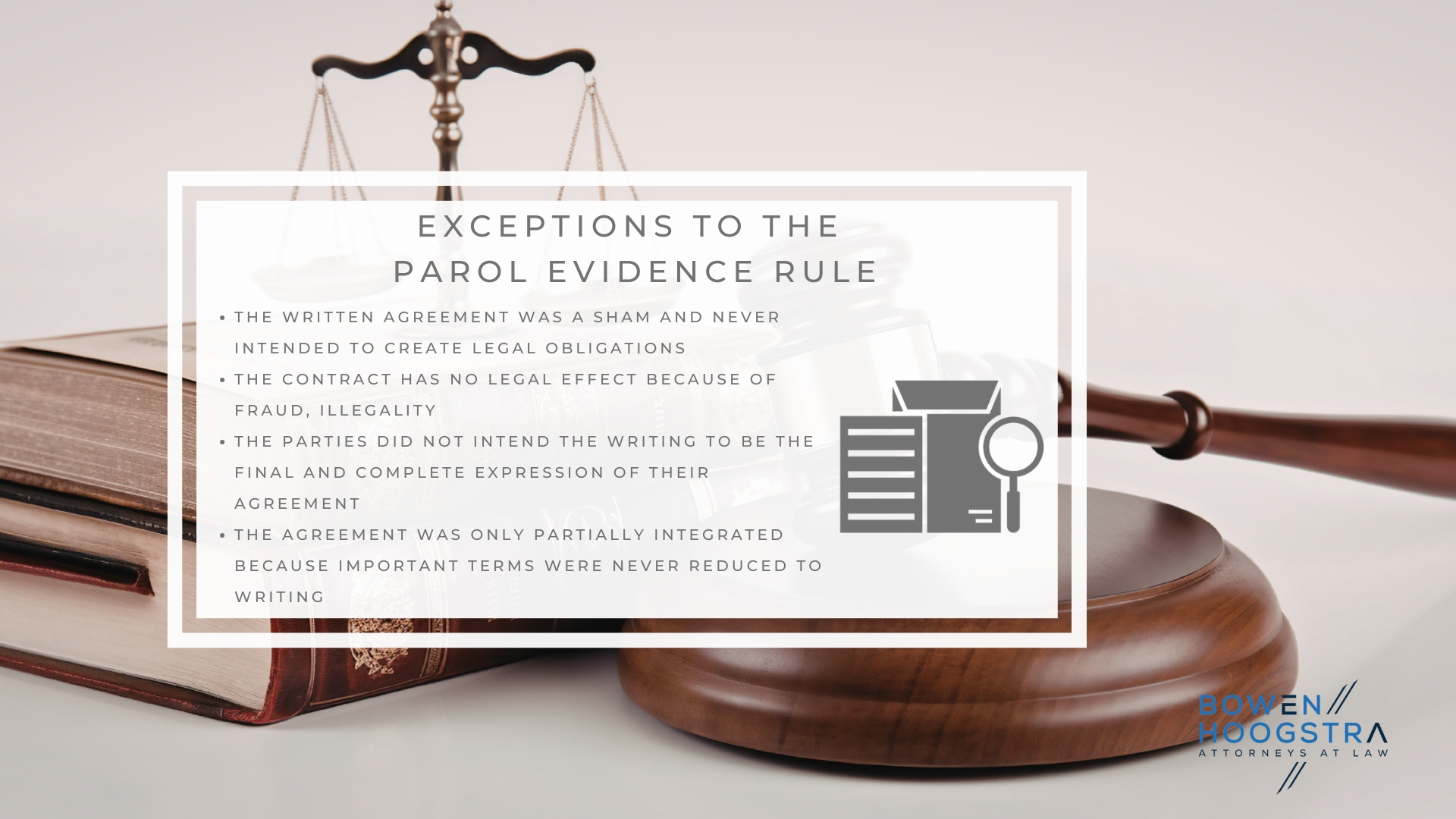
However, there are important exceptions to the parol evidence rule. Michigan courts might consider extrinsic evidence to show that:
- the written agreement was a sham and never intended to create legal obligations;
- the contract has no legal effect because of fraud, illegality, or mistake;
- the parties did not intend the writing to be the final and complete expression of their agreement; or
- the agreement was only partially integrated because important terms were never reduced to writing.
If one party, for instance, claims the written contract was signed only as a formality and was never meant to be binding, the court might allow outside evidence to determine whether the document was a sham. Likewise, if you can show that the contract was signed based on fraudulent misrepresentations, the court might consider evidence beyond the written terms. In these situations, extrinsic evidence is not used to change clear language, but to determine whether a valid and fully integrated contract actually exists in the first place.
Common Interpretation Issues in Business and Construction Disputes
In business and construction disputes, contract interpretation often centers on conflicting clauses or internal inconsistencies. One section might appear to say one thing, while another says something different. Michigan courts try to read the contract as a whole and harmonize the provisions so that each clause has meaning. Courts further look at whether a term was specifically negotiated or simply a standard boilerplate provision. If there is conflict, negotiated terms often carry more weight than generic, preprinted language.
Furthermore, when a contract is silent or leaves gaps, you might assume that silence works in your favor. But courts do not simply guess. Instead, judges might apply default legal rules, look at industry standards, or determine whether an implied warranty exists based on the structure of the agreement. In some cases, silence can create uncertainty that leads to costly litigation. That’s exactly why careful drafting matters. Working with qualified business lawyers in Muskegon, MI, can help you reduce the risk of disputes and make sure your agreements clearly reflect your expectations before problems arise.
Why Contract Interpretation Disputes Require Legal Guidance
When a contract dispute reaches a Michigan trial court, the outcome often depends on how the judge applies the rules of contract interpretation. Small differences in wording can lead to major financial consequences. A single sentence might determine whether you get paid, whether you owe damages, or whether a deal moves forward at all. Once litigation begins, you’re no longer just arguing about what feels fair, but dealing with strict legal standards that control how the court reads and enforces your agreement.
The best time to protect yourself is when the contract is being drafted or reviewed. That’s why it helps to have experienced legal support as early as possible. Let Bowen Hoogstra Law guide you at every stage of the process. We review, draft, and negotiate contracts with clarity and precision. If a conflict arises, our competent business lawyers in Muskegon, MI, can help you understand where you stand and what options you have to resolve the dispute efficiently. Contact us today at (231) 726-4484 or here to schedule a consultation.