
Creating a will ensures your assets are distributed according to your wishes after you pass away. But before a will is considered valid under Michigan law, the person making it must have testamentary capacity. That means you have the mental fitness to understand what you’re doing and the consequences of your decisions at the time you signed your will. Let our qualified probate lawyer in Muskegon, Michigan, discuss what factors courts consider when determining the testamentary capacity of a person to make a will.
- What Is Testamentary Capacity in Michigan?
- Factors Courts Consider When Evaluating Mental Fitness
- Common Challenges to Testamentary Capacity
- Proving or Defending Testamentary Capacity in Probate Court
- Why You Need a Probate Lawyer in Muskegon, MI
What Is Testamentary Capacity in Michigan?
Under Michigan law, an individual who is 18 years or older and has sufficient mental capacity can make a valid will. But what does sufficient mental capacity actually mean? Courts look at four specific requirements, and all of them must be met at the time the will is signed.
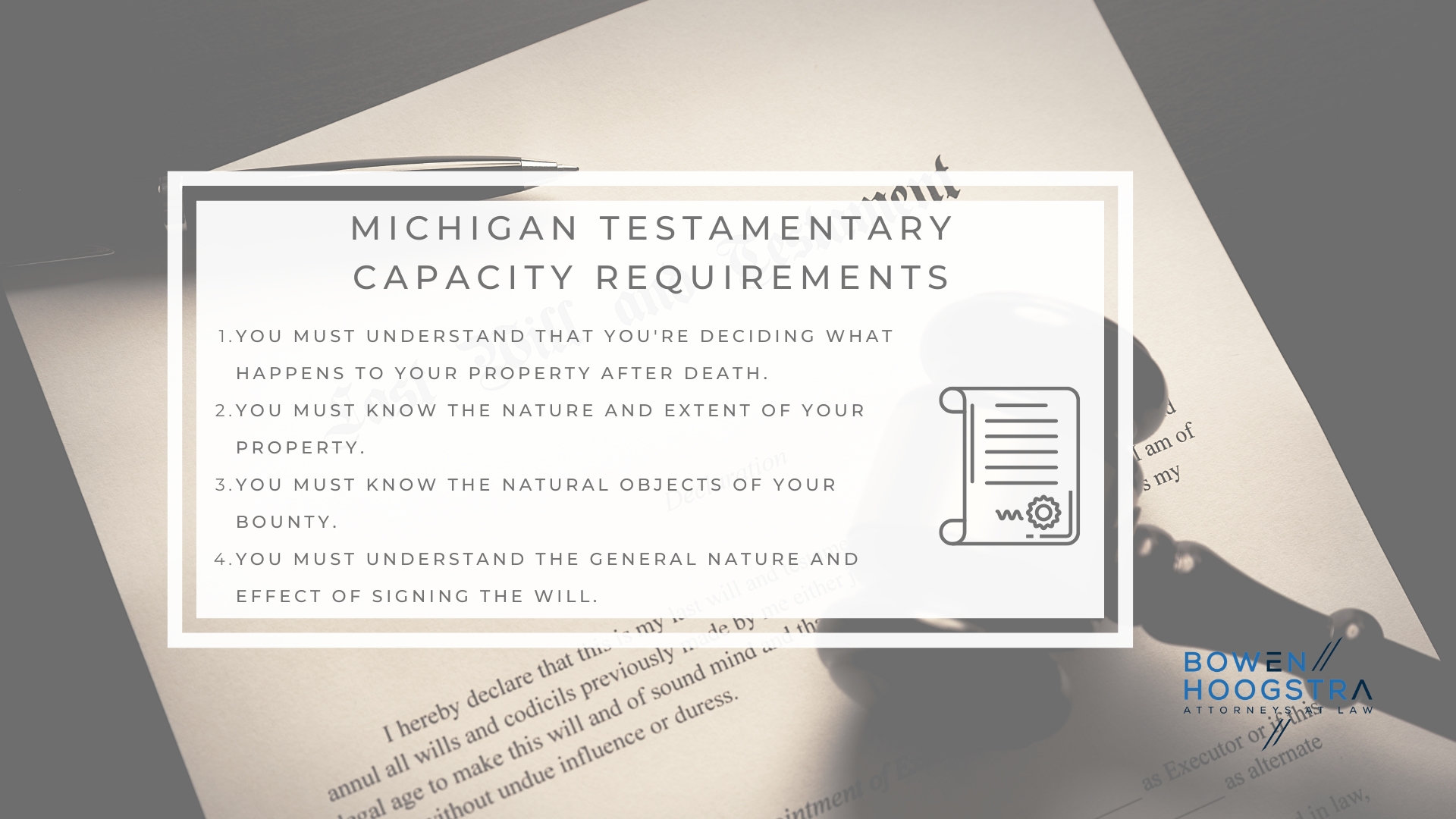
- You must understand that you’re deciding what happens to your property after death.
The requirement focuses on your awareness of the purpose of a will, meaning you must grasp that signing a will is a way of giving instructions about who will receive your assets after you pass away. That basic understanding ensures that the act of making a will is intentional and deliberate, not something done under confusion or misunderstanding.
- You must know the nature and extent of your property.
To meet the requirement, you don’t need to know every item you own down to exact numbers or dollar amounts. But you should have a general knowledge of what you own, including your home, bank accounts, investments, personal belongings, and other assets. That awareness helps show you’re making informed decisions about your estate.
- You must know the natural objects of your bounty.
The requirement means you must know who your close relatives or intended beneficiaries are. Usually, these include your spouse, children, and sometimes other close family members. It ensures that you’re not mistakenly disinheriting someone because you forgot such persons exist or failed to recognize your relationship with them.
- You must understand the general nature and effect of signing the will.
The requirement looks at whether you understood what you were doing when you signed the document. It doesn’t require legal expertise; you just need to have a fundamental understanding that signing the will finalizes your decisions about your estate and gives legal authority to your instructions with regard to the posthumous transfer of your assets.
Testamentary capacity serves as a safeguard for both the testator and their beneficiaries. Without it, a will might be vulnerable to disputes from family members who believe the person was not mentally fit to make such decisions.
Factors Courts Consider When Evaluating Mental Fitness
Probate courts examine mental fitness at the time the will was executed. Having a medical condition, such as memory loss, dementia, or other cognitive issues, doesn’t automatically mean a person lacks testamentary capacity. What matters is whether the testator had lucid intervals or moments of clarity at the time of signing. If the will was executed during such a moment, it remains legally valid.
Furthermore, Michigan law recognizes that many people in their 70s, 80s, or even 90s maintain full testamentary capacity. Mild forgetfulness, slower processing, or normal age-related cognitive decline do not disqualify someone from making a will. For example, an elderly person who occasionally forgets names or misplaces items might still fully understand the purpose and consequences of making a will.
Common Challenges to Testamentary Capacity
Disputes over testamentary capacity often happen when family members believe the testator was not mentally capable at the time the will was signed. Moreover, allegations of undue influence or coercion are common, particularly when a beneficiary receives a surprisingly large share of the estate or when the testator was dependent on someone who might have pressured them. These claims usually attempt to demonstrate that the will doesn’t reflect the true intentions of the testator.
During probate, courts rely heavily on persuasive evidence to determine whether the will is valid. A will drafted during a period of hospital stays or major medical events might face more scrutiny. On the other hand, detailed notes from the drafting probate lawyer in Muskegon, Michigan, consistent estate planning patterns, and clear discussions recorded in writing or through witness statements can help show that the testator had sufficient testamentary capacity at the time of execution.
Proving or Defending Testamentary Capacity in Probate Court
When a will is challenged, both the challenger and the defender must present evidence to support their position. If you believe the testator lacked testamentary capacity, your goal is to show that the said testator did not meet one or more of the legal requirements at the time the will was signed. Effective strategies include:
- Showing inconsistent or unusual decisions in the will
- Collecting medical records showing cognitive impairment
- Identifying sudden or unexplained changes to prior estate plans
- Presenting testimony from caregivers, family members, or friends who observed confusion
Meanwhile, if you are defending the validity of the will, you need to show that the testator did have the required mental capacity and acted freely. Common strategies include:
- Gathering medical evaluations that confirm mental clarity
- Showing consistent estate planning patterns that align with the will
- Providing documentation such as written notes or letters from the testator
- Presenting witness testimony from the attorney or individuals present at the signing
Expert witnesses can help the court assess whether the testator met the Michigan legal standard for testamentary capacity, ensuring the decision is grounded in credible, professional evaluations. Medical or psychological experts can testify about the cognitive condition of the testator, while the local lawyer in Muskegon, Michigan, who drafted the will can attest to the demeanor of the testator during its execution.
Why You Need a Probate Lawyer in Muskegon, MI
If a dispute involving testamentary capacity arises, Bowen Hoogstra Law is ready to guide you through every stage of the probate process. Our competent lawyers in Muskegon, Michigan, work closely with medical experts, witnesses, and families to build strong, fact-based arguments that protect your rights and the integrity of the estate. Contact us today at (231) 726-4484 or here to schedule a consultation. Let us provide you with the legal support and representation you deserve.