
Construction projects in Michigan bring together property owners, contractors, subcontractors, suppliers, and design professionals. With so many moving parts, it’s no surprise that disputes can arise. These construction disputes often involve disagreements about contracts, payments, timelines, or the quality of work performed.
- Why Alternative Dispute Resolution Matters in Michigan Construction Cases
- Mediation in Michigan Construction Disputes
- Arbitration in Michigan Construction Disputes
- Mediation vs. Arbitration: Choosing the Right Path for Your Dispute
- Why You Need Legal Guidance in Construction ADR
The courtroom was the default place to settle these issues, but litigation is often expensive, stressful, and time-consuming. Fortunately, there are now more efficient options available. Alternative Dispute Resolution (ADR) methods, such as mediation and arbitration, give you a chance to resolve conflicts without going through a trial.
Let our competent Muskegon construction attorney explain how ADR works in Michigan construction disputes and break down the differences between mediation vs. arbitration.
Why Alternative Dispute Resolution Matters in Michigan Construction Cases
In Michigan, the courts strongly encourage parties to settle disputes outside of the courtroom whenever possible. In fact, less than 1.5 percent of civil cases filed in Michigan circuit courts are resolved through trial each year. That means most cases, including construction disputes, are settled or resolved through some form of ADR.
ADR is particularly useful in construction conflicts because these disputes often involve complicated matters, including unclear contract terms, disagreements over payments, or construction defects, all of which can drag on for years in court. ADR provides a path that is quicker and generally more cost-effective.
Furthermore, ADR offers privacy and flexibility. Court cases are public record, but ADR can be kept confidential, which is important if you want to protect sensitive information. The process can be tailored to the specific needs of the parties, allowing for more practical and business-focused solutions than what Muskegon courts might impose.
For these reasons, many parties turn to a Muskegon construction attorney to help guide them through ADR instead of pursuing a drawn-out court trial. Local lawyers can explain the advantages of each option and recommend the best path forward depending on the nature of your Michigan construction dispute.
Mediation in Michigan Construction Disputes
In mediation, a neutral third party, the mediator, facilitates discussions between the parties. The job of the mediator isn’t to decide who’s right or wrong, but rather to help both sides communicate, clarify their concerns, and work toward a mutually agreeable solution.
How Mediation Works
The process starts with the parties presenting their perspective. The mediator then guides negotiations, asking questions and suggesting ways to bridge gaps. Unlike a judge or arbitrator, the mediator has no authority to impose a decision. The outcome is entirely up to the parties.
Advantages of Mediation
Mediation is cost-effective. Because the process is quicker and less formal than litigation, you spend less money on legal fees. Moreover, it allows for creative solutions that a court ruling might not provide, such as revising payment schedules or adjusting project timelines.
Limitations of Mediation
That said, mediation isn’t perfect. Because it’s voluntary, there’s no guarantee of resolution. If one party refuses to compromise, the mediation might end without an agreement. In that case, you might have to move on to arbitration or litigation to resolve the dispute.
Arbitration in Michigan Construction Disputes
While mediation focuses on negotiation, arbitration is more formal and resembles a private court process. A neutral third party, the arbitrator, listens to both sides, reviews the evidence, and then makes a decision. Unlike mediation, the decision of the arbitrator is binding, meaning both parties are legally required to follow it.
How Arbitration Works
The process begins with both parties agreeing to arbitration, often because their contract requires it. Each side presents evidence, witnesses, and arguments, similar to a courtroom trial. After reviewing the information, the arbitrator issues a written decision, which can be enforced in court if necessary.
Advantages of Arbitration
Arbitration is generally faster than going to court, meaning you can resolve the conflict and move on with your project more quickly. The outcomes are legally enforceable, providing certainty once a decision is reached. Furthermore, arbitrators with industry-specific experience are often available, giving you someone who understands the technical aspects of construction projects.
Limitations of Arbitration
Arbitration does have drawbacks. The right to appeal the decision of an arbitrator is very limited, so you might be stuck with the result even if you believe it’s unfair. While arbitration is usually faster than litigation, it can still become expensive, especially if multiple arbitrators are involved or if the process stretches out.
Mediation vs. Arbitration: Choosing the Right Path for Your Dispute
Both mediation and arbitration fall under the umbrella of Alternative Dispute Resolution, but work very differently. Here’s a quick comparison to help you see the key distinctions:
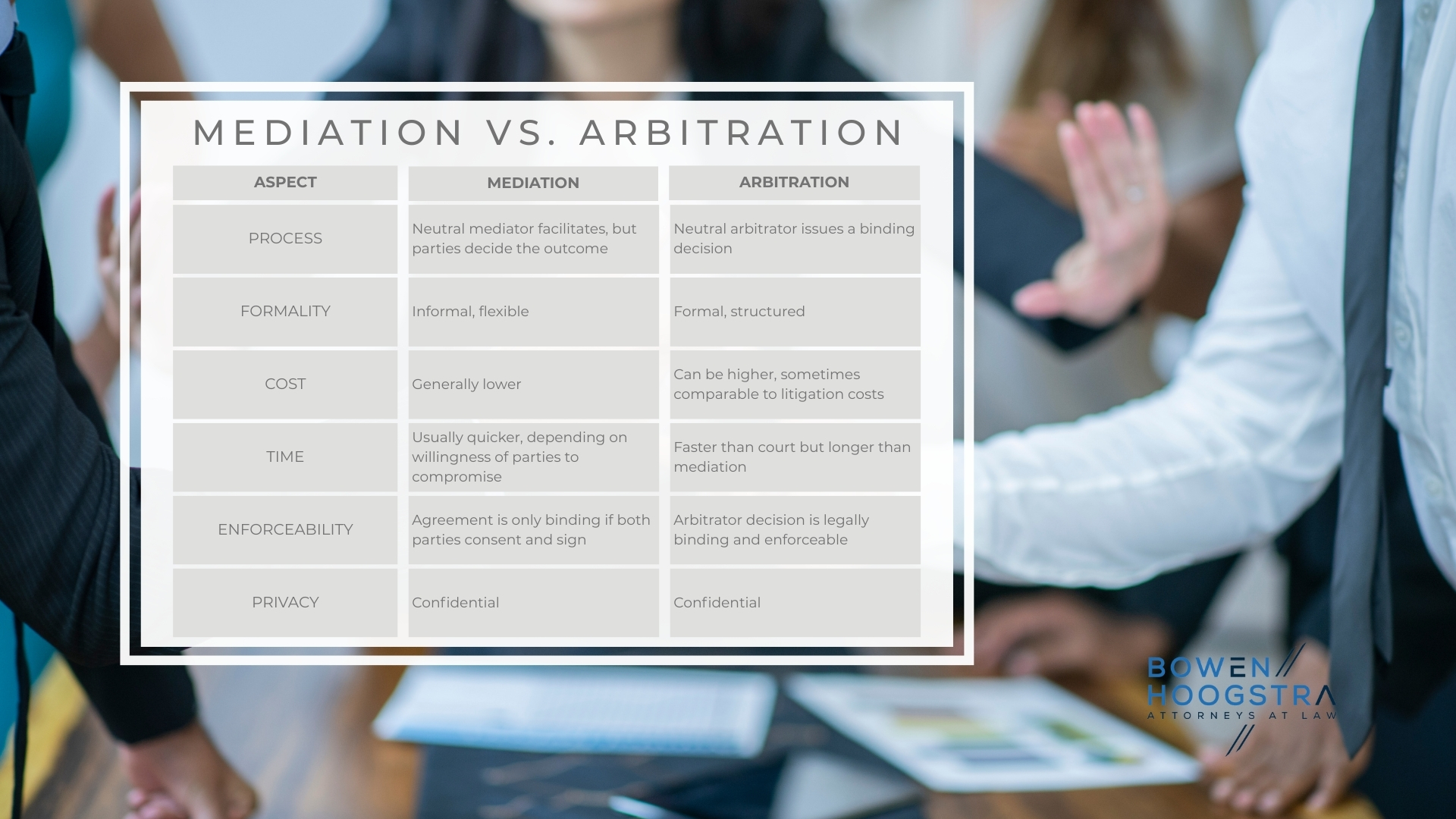
| Aspect | Mediation | Arbitration |
| Process | Neutral mediator facilitates, but parties decide the outcome | Neutral arbitrator issues a binding decision |
| Formality | Informal, flexible | Formal, structured |
| Cost | Generally lower | Can be higher, sometimes comparable to litigation costs |
| Time | Usually quicker, depending on willingness of parties to compromise | Faster than court but longer than mediation |
| Enforceability | Agreement is only binding if both parties consent and sign | Arbitrator decision is legally binding and enforceable |
| Privacy | Confidential | Confidential |
When weighing mediation vs. arbitration, think about your goals. If preserving your working relationship is essential, mediation may be the better choice. If you need a definitive, legally enforceable outcome, arbitration might be the way to go. A qualified Muskegon construction attorney can guide you toward the best approach for your situation.
Why You Need Legal Guidance in Construction ADR
Before you commit to mediation or arbitration, it’s important to understand what your contract actually says. Many Michigan construction agreements include ADR clauses that can determine whether you’re required to mediate first, move directly to arbitration, or even follow specific rules for the process. Misunderstanding the language can leave you locked into a process that might not work in your favor.
Bowen Hoogstra Law can help review your contract, explain your options, and guide you through the ADR process. Our experienced Muskegon construction attorneys make sure your rights are protected during negotiations or hearings, so you aren’t pressured into an unfavorable settlement or bound by a decision you don’t fully understand. Contact us today at (231) 726-4484 or here to schedule a consultation.