Construction projects involve more than completing work and sending invoices. Money often moves through several levels, from an owner to a general contractor and then to subcontractors, suppliers, and laborers. If someone lower in that payment chain is not paid, the problem can eventually affect the property itself through a construction lien. That’s why the Michigan payment process includes documents designed to show who is owed money and whether lien rights still exist.
- What a Sworn Statement Is in Michigan Construction Projects
- When Sworn Statements Are Required
- Payment Risks Created by Inaccurate or Missing Statements
- How Sworn Statements Affect Lien Rights and Defenses
- Reducing Payment and Lien Exposure on Michigan Projects
Under the Michigan Construction Lien Act, contractors and subcontractors have to provide sworn statements at specific points in the payment process. An inaccurate or missing statement can delay payment, create disputes, and leave owners exposed to lien claims. Let our competent Muskegon construction attorney elaborate on when sworn statements are required and how contractors and owners can use them to reduce payment and lien risks on Michigan construction projects.
What a Sworn Statement Is in Michigan Construction Projects
A sworn statement is a written disclosure that identifies the subcontractors and suppliers with whom the contractor or subcontractor has contracted for the improvement. It specifies certain laborers who are owed unpaid wages, fringe benefits, or withholdings and states the amounts due. The statutory form includes the name and contact information of the party, the type of improvement furnished, the total contract price, amounts already paid, amounts currently owing, and other payment details. In practical terms, the statement gives the owner or contractor a clearer picture of where project funds still need to go before another payment is released.
A sworn statement is not the same as a waiver of lien or a notice of furnishing. A lien waiver releases construction lien rights to the extent stated in the waiver, while a notice of furnishing generally notifies designated project parties that a subcontractor, supplier, or laborer is furnishing labor or materials and might preserve lien rights. The sworn statement instead focuses on the payment chain and outstanding amounts. Owners, general contractors, and subcontractors rely on accurate statements to compare the disclosed amounts with invoices, payment records, notices of furnishing, and lien waivers before deciding where project funds should be paid.
When Sworn Statements Are Required
Michigan law requires a contractor to provide a sworn statement to the owner or lessee when payment is due, when the contractor requests payment, or when the owner or lessee demands one. A subcontractor must provide a sworn statement to the contractor when payment is due or requested, and to the owner or lessee when the owner or lessee makes a qualifying demand. These rules make sworn statements part of both progress-payment and final-payment procedures rather than something that matters only when a lien dispute has already begun.
Note that completeness matters because the document is supposed to show the payment status of parties involved in the improvement at the time money is being requested or released. If required information is missing or inconsistent with other project records, the receiving party might have reason to stop and investigate before paying. The Michigan Construction Lien Act provides that failing to supply a required sworn statement does not necessarily invalidate a lien, but it can prevent payment or enforcement of the lien until the statement is provided.
Payment Risks Created by Inaccurate or Missing Statements
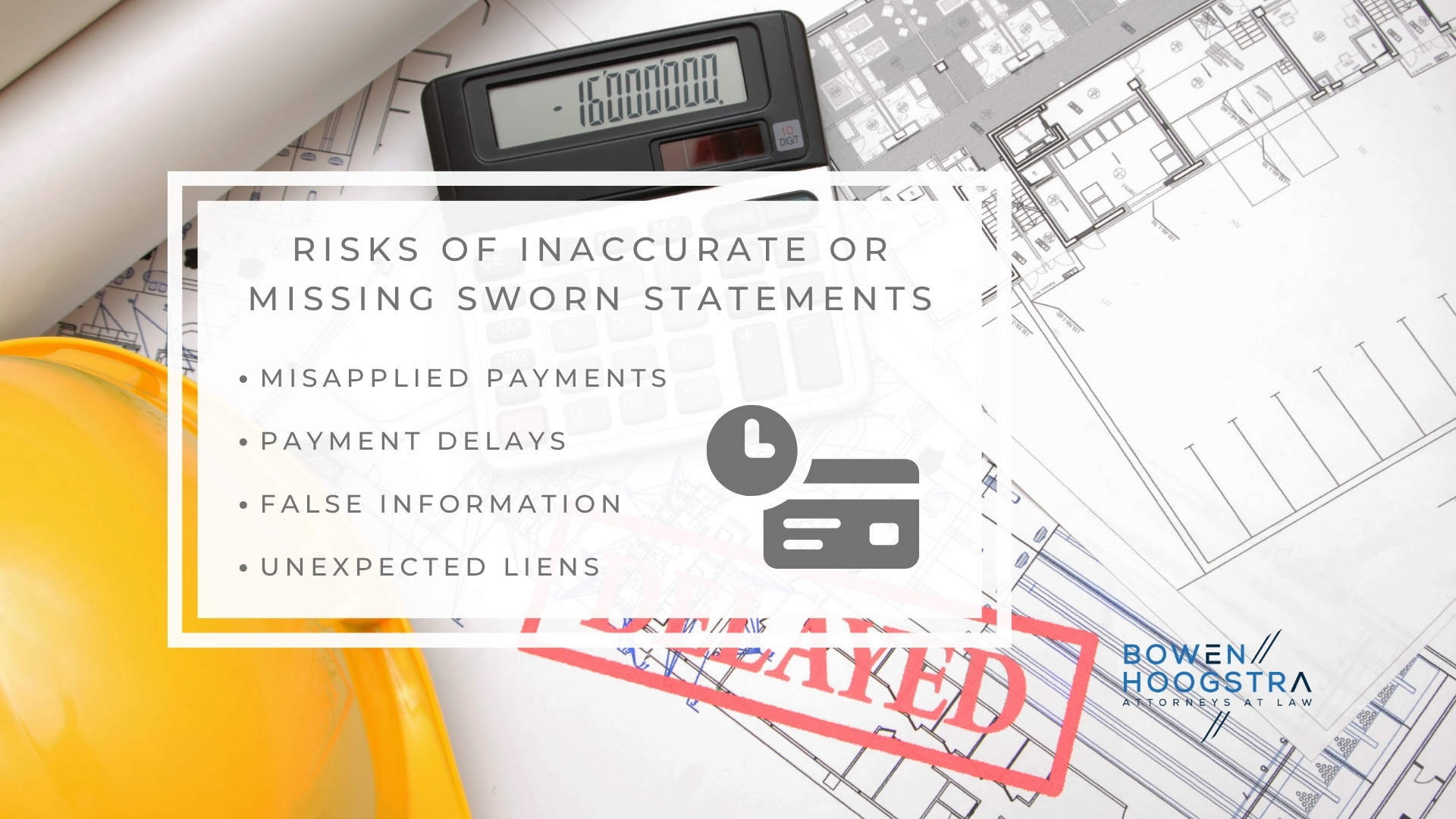
A sworn statement helps connect a draw request with the unpaid individuals and companies behind the work. When the information is wrong, or the statement is not provided, the next payment can create problems instead of resolving them.
Misapplied Payments
An owner might pay the general contractor in full based on the belief that lower-tier parties have already been paid, only to discover that a subcontractor or supplier is still owed money. Michigan law allows an owner or lessee, after receiving a sworn statement, to withhold enough money to cover sums shown as due to subcontractors, suppliers, laborers, or certain lien claimants. In appropriate circumstances, those funds might be paid directly to the parties who are owed.
Payment Delays
Missing sworn statements can stop the payment process. An owner reviewing a progress draw might be unwilling to release funds without the required disclosure, and a general contractor might take the same position when a subcontractor requests payment. The Act specifically ties the obligation to provide sworn statements to certain payment requests and amounts due, and a contractor who has not provided a required statement might be unable to obtain payment until the requirement is satisfied.
False Information
A sworn statement should never be treated as a routine form that can be completed from memory or adjusted simply to get a draw approved. Under the Michigan Construction Lien Act, a contractor or subcontractor who, with intent to defraud, gives or causes a false sworn statement to be given to an owner or lessee in order to draw money can face criminal penalties. False information can further become central to civil disputes over payment, reliance, fraud allegations, or responsibility for losses.
Unexpected Liens
Owners who assume that a clean-looking sworn statement means the property cannot be liened face a particular risk. The Act specifically limits when an owner or other party might rely on a sworn statement to avoid claims, including situations involving claimants who have provided a notice of furnishing or whose notice requirement is excused. That means an owner can believe the project has been fully paid and still face a lien claim if notices, waivers, or unpaid amounts were overlooked.
How Sworn Statements Affect Lien Rights and Defenses
A sworn statement can help identify potential lien claimants before a payment dispute grows. If a subcontractor or supplier is listed with an unpaid balance, the owner or general contractor can compare that amount with notices of furnishing, invoices, previous draw requests, checks, and lien waivers. Differences between those records can reveal that a payment has not cleared or a lower-tier party has not been accounted for. During litigation, inconsistent sworn statements and payment records might become important evidence about what the parties represented and knew when funds were released.
At the same time, a sworn statement does not automatically eliminate all lien risk. Michigan law allows certain parties to rely on a statement in some circumstances, but that protection is limited. Moreover, contractors and subcontractors do not necessarily lose an otherwise valid lien simply because a required sworn statement was missing. Instead, the Act can delay payment or prevent an enforcement action until the statement is supplied. A local Muskegon construction attorney can help you evaluate how the sworn statement, notices, waivers, and actual payment history fit together when construction lien rights are disputed.
Reducing Payment and Lien Exposure on Michigan Projects
A reliable payment process starts with documentation that is reviewed before money changes hands. Owners must require updated sworn statements when the law or contract calls for them and compare each statement with the current draw request, invoices, notices of furnishing, and prior payments. Contractors, on the other hand, must make sure the amounts reported match their own accounting records. Keeping organized records can make it much easier to resolve any discrepancies.
Bowen Hoogstra Law can help contractors, subcontractors, property owners, and other project participants understand their rights and obligations under the Michigan Construction Lien Act. Our seasoned Michigan construction attorneys can review sworn statements, payment records, lien waivers, notices of furnishing, and disputed lien claims to help identify the next appropriate step. Contact us today at (231) 726-4484 or here to discuss your construction payment or lien issue.