
Joint ownership of property can work well when everyone shares the same plans. Problems often begin when the owners have different ideas about how the property should be used, maintained, or sold. One person might want to live in the home, while another might want to rent it out or sell it. These disagreements can become even more difficult when the property was inherited and carries emotional or financial value for the family.
- What a Partition Action Is Under Michigan Law
- When a Co-Owner Can Seek Partition
- How Michigan Courts Handle Partition Cases
- Protecting Your Interests in a Co-Ownership Dispute
Co-owners often try to resolve the dispute through discussions or a private sale. However, these options only work when everyone is willing to cooperate. When the owners reach a deadlock, Michigan law provides a court process that can end the shared ownership. That process is known as a partition action. Depending on the property and the circumstances, the court might divide the land, order a sale, or address financial issues between the owners.
Let our experienced business lawyer in Muskegon, MI, explain how Michigan partition actions work, when a co-owner can file one, and how the process can resolve disputes involving jointly owned property.
What a Partition Action Is Under Michigan Law
A partition action is a civil lawsuit used to divide or end the shared ownership of real property. Under Michigan law, people who hold property as joint tenants or tenants in common can generally seek partition, and these cases are filed in circuit court as equitable proceedings. The action becomes necessary when the owners cannot voluntarily agree on what to do with the property.
For instance, suppose three siblings inherited a Muskegon property from their parents. One sibling wants to move into the property, another wants to use it as a rental for income, and the third wants to sell it and receive their share of the money. If no agreement is reached between the siblings, one of them can file a partition action and ask the Muskegon circuit court to resolve the ownership dispute.
Partition actions provide a legal path forward when private negotiations have failed. The court can examine the ownership interests and decide whether the property can be physically divided without causing serious harm to its value or the owners. When a fair physical division is not practical, the court might order the property sold and distribute the remaining proceeds according to the rights of each owner.
When a Co-Owner Can Seek Partition
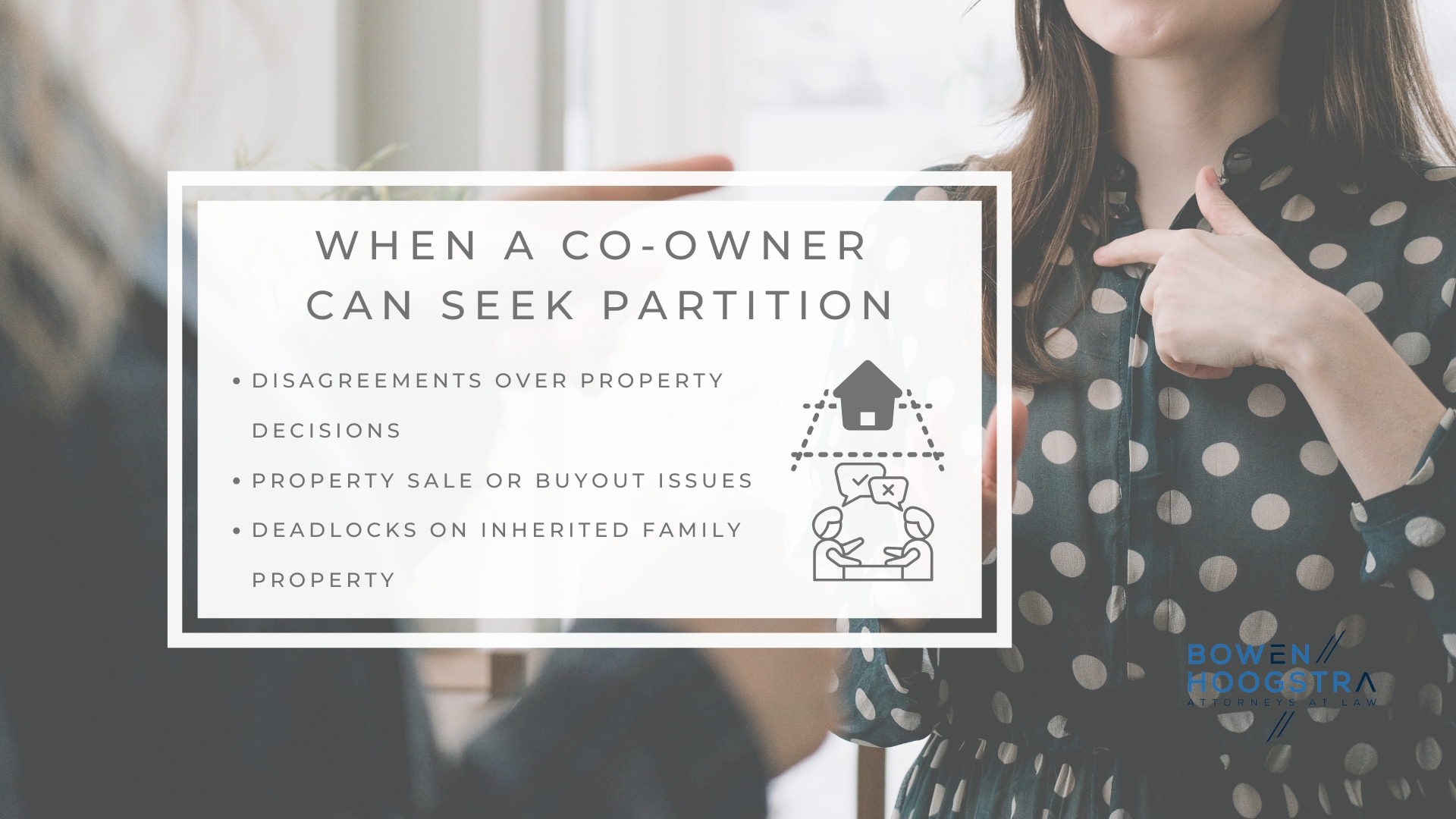
A co-owner does not necessarily have to prove that another co-owner committed misconduct before seeking partition. A partition action might be considered when co-owners can no longer make important decisions about the property together.
Property Decisions
Disputes often arise when co-owners disagree about whether to sell, occupy, lease or rent, repair, or improve the property. For example, one co-owner might live in the home and treat it as a primary residence, while the other owners receive no rental income and cannot use it freely. Perhaps the owners might disagree about who should pay property taxes, insurance, mortgage payments, maintenance costs, or repairs. Owners can always negotiate an agreement outside the court, but when the issues remain unresolved and prevent the property from being managed effectively, a co-owner can seek partition to establish a legally binding outcome.
Sale or Buyout
One owner might want to convert their ownership interest into money while another wants to keep the property. The owner who wishes to stay can offer to purchase the share of the departing owner. However, disagreements might still arise over the fair market value of the property or the terms of payment. A co-owner generally cannot be forced to remain indefinitely in an unwanted ownership arrangement simply because another owner does not want to sell. When a voluntary buyout cannot be negotiated, a partition action might allow the court to divide the property or order a sale when physical division is unequitable.
Family Property
Inherited family property can create particularly difficult deadlocks because financial interests often become connected with personal history and emotional attachment. Several relatives might inherit a house or parcel of land without any written agreement about who can live there or who must pay expenses. Moreover, the number of owners can increase as interests pass to later generations, making unanimous decisions more complicated. When the heirs cannot reach a practical agreement, partition can provide a structured legal process to settle ownership rights and determine whether the disputed property should be divided or sold.
How Michigan Courts Handle Partition Cases
Michigan courts resolve partition cases through either partition in kind or partition by sale. Partition in kind physically divides the property into separate parcels, allowing each co-owner to receive an individual portion. Meanwhile, partition by sale involves selling the entire property and dividing the net proceeds among the owners according to their legal interests. When deciding whether physical division is reasonable, a court typically considers the size and layout of the property, access to roads and utilities, the effect of division on the property value, and financial contributions of each owner.
In the past, when one heir wanted to sell inherited property, the court could order a partition by sale even when the remaining family members wanted to keep it. The Michigan Uniform Partition of Heirs Property Act (UPHPA), effective on April 2, 2025, added protections for certain inherited properties held by relatives as tenants in common. Under the Act, co-owners who did not request the sale have an opportunity to purchase the interests of those who did. If no complete buyout occurs, the law favors partition in kind, unless dividing the property would cause great prejudice to the co-owners as a group.
A court might order a sale when physical division is economically impractical or would substantially reduce the total value of the property. For example, suppose three siblings inherit a lakefront lot containing one cottage. The court cannot reasonably divide one house into three independently usable properties, and splitting the lot might violate local land-use requirements or leave some parcels without road or lake access. In addition, the combined value of the divided parcels might be much lower than the property value as a whole. In that situation, a sale might serve the collective interests of the co-owners.
Protecting Your Interests in a Co-Ownership Dispute
Litigation is not the only way to resolve a co-ownership disagreement. Before filing a lawsuit, you can always negotiate a voluntary sale, arrange a buyout, divide multiple parcels among the owners, or create a property-use contract. An agreement in place can reduce legal expenses and give you more control over the outcome. The agreement must be clearly documented so that each owner understands their rights and obligations. When negotiations fail, a qualified legal professional can help you pursue a partition action or defend your ownership interests after another co-owner files one.
Let Bowen Hoogstra Law guide you toward the most practical way to resolve a dispute involving jointly owned real estate. Our competent business lawyer in Muskegon, MI, can review deeds, inheritance records, financial contributions, property valuations, and proposed buyout terms. We can negotiate with the other owners and represent your interests in court when necessary. Since partition cases can affect valuable property and important family relationships, early legal guidance ensures you avoid preventable mistakes. Contact us today at (231) 726-4484 or here to discuss your case.