

Buying a Michigan property gives you significant rights, but those rights are not always unlimited. A home or parcel of land can be subject to restrictions, created years or even decades before you became the owner, that control how the property can be used, what can be built on it, or what activities are allowed. These restrictions matter when you plan to make property improvements, enter into a rental or lease agreement, or use the property for business purposes.
- What Deed Restrictions Are and How They Work
- When Deed Restrictions Are Enforceable in Michigan
- Common Disputes Involving Restrictive Covenants
- Legal Options for Enforcing or Challenging a Restriction
- Protecting Your Property Rights in a Deed Restriction Dispute
Let our competent Muskegon real estate lawyer further discuss how deed restrictions in Michigan work and the legal options available when a certain restriction interferes with your property rights.
What Deed Restrictions Are and How They Work
A deed restriction, often called a restrictive covenant, is a private limitation placed on real property through a Michigan deed, declaration, or other recorded instrument. It might limit the property to residential use, establish minimum setbacks, regulate structures, restrict rentals, or impose other conditions on development and use. Many restrictions are designed to run with the land, meaning restrictive covenants continue to burden or benefit the property even after ownership changes.
When Deed Restrictions Are Enforceable in Michigan
Michigan courts generally enforce an unambiguous deed restriction according to its written terms unless it violates the law or public policy or an applicable defense defeats enforcement. At the same time, restrictive covenants are strictly construed against the party seeking to enforce them, and genuine uncertainty is resolved in favor of the free use of property. Courts try to determine the intent behind the covenant rather than expand the restriction beyond what its language reasonably covers.
However, even a valid restriction might become difficult to enforce under certain circumstances. A property owner, for instance, might argue that the restriction was waived or abandoned because similar violations were knowingly allowed for a significant period, although minor violations do not necessarily eliminate the right to enforce it. Dramatic changes in neighborhood conditions can further affect enforcement when the original purpose of a restriction can no longer reasonably be achieved.
Moreover, some covenants are unlawful regardless of their wording. Under the Discharge of Prohibited Restrictive Covenants Act, prohibited restrictions that attempt to limit property occupancy or ownership based on race, color, religion, sex, familial status, national origin, or another class protected by the federal Fair Housing Act are void and cannot be enforced. Nonetheless, the statute provides procedures for removing such prohibited language from recorded property documents.
Common Disputes Involving Restrictive Covenants
Deed restriction disputes often begin when one owner changes how a property is used or improved and another owner, association, or developer believes the change violates recorded covenants.
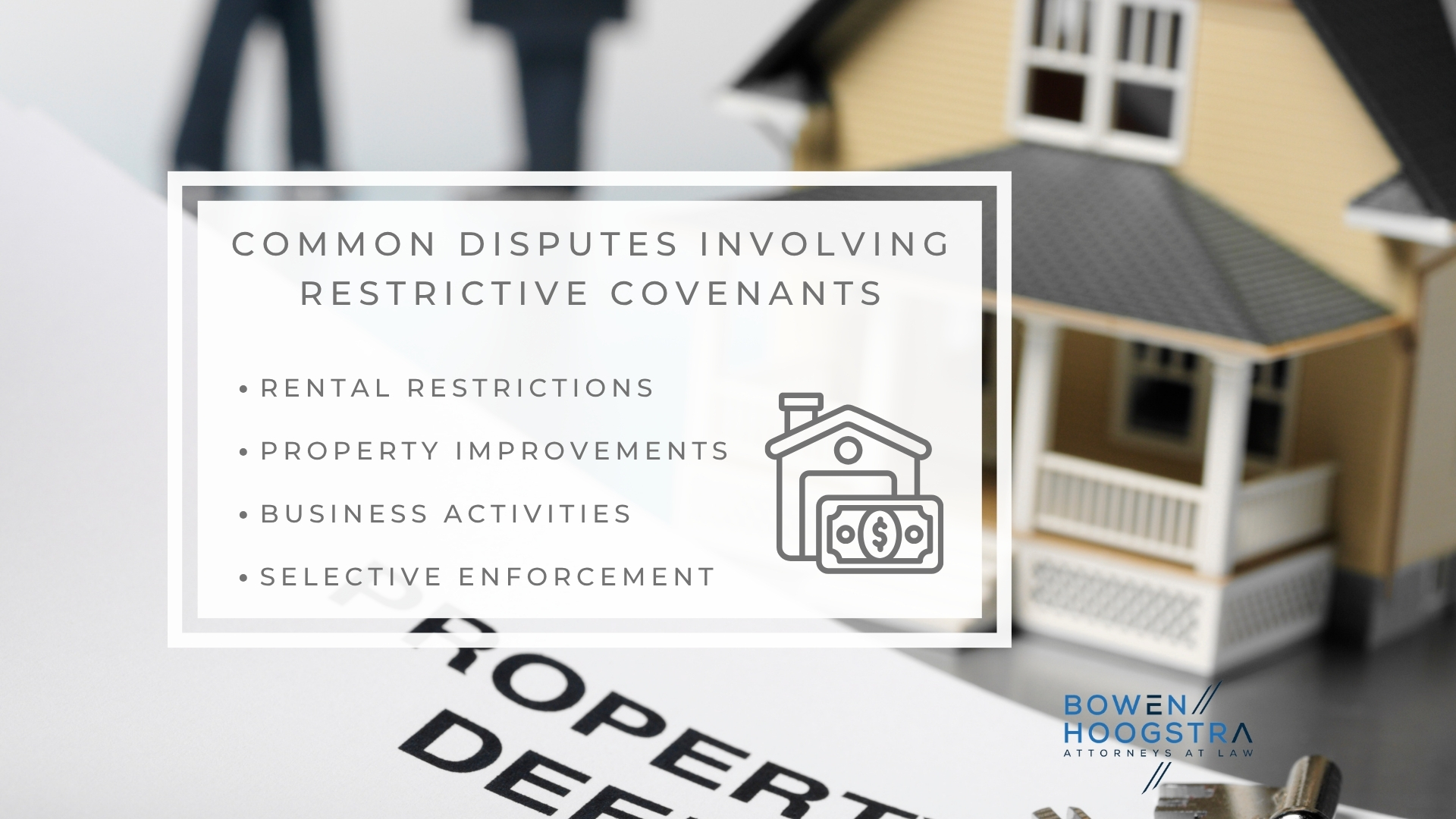
Rental Restrictions
Rentals can cause conflicts when a covenant limits property to residential or noncommercial use. Whether a rental violates a deed restriction depends on the specific language of the covenant. In Melvin R. Berlin Revocable Trust v. Rubin, for instance, the Michigan Supreme Court held that short-term rentals violated a restrictive covenant limiting property use to “single-family residence purposes.”
Property Improvements
Home additions, detached garages, sheds, fences, decks, and other improvements often lead to deed restriction disputes. A restrictive covenant might establish setbacks that are stricter than local zoning requirements or require approval before construction begins. Having a municipal permit or zoning variance does not necessarily eliminate obligations created by a private deed restriction.
Business Activities
Restrictions limiting property to residential use might create problems when an owner starts a business from the property. The dispute might involve frequent customer visits, employee traffic, deliveries, signage, or other activities that change how the property is used. Even minor business operations can lead to a civil lawsuit if the recorded covenant clearly prohibits commercial or business activity.
Selective Enforcement
Owners sometimes challenge the enforcement of deed restrictions in Michigan, pointing to similar violations that were previously allowed. But selective or inconsistent enforcement does not automatically make a restrictive covenant unenforceable. Muskegon courts consider whether prior violations were substantial enough to show waiver, abandonment, changed conditions, or another equitable defense.
Legal Options for Enforcing or Challenging a Restriction
When another property owner violates a deed restriction, you can ask the court for an injunction. An injunction is a legal order that can require someone to stop a prohibited use, halt construction, remove an improvement, or otherwise comply with the restrictive covenant. When the disagreement concerns what a restriction actually means, a property owner can seek declaratory relief, asking the court to determine the rights of the parties and clarify whether the restriction applies to the disputed activity.
If you are challenging enforcement, inconsistent enforcement or changed neighborhood conditions can support your position, depending on the circumstances. Litigation is not always necessary. Owners might be able to negotiate a written release, an amendment, a permitted exception, or settlement terms that define the permitted use. Any negotiated change must be carefully documented and properly recorded so future owners can determine what restrictions still apply.
Protecting Your Property Rights in a Deed Restriction Dispute
A restrictive covenant dispute can affect what you can do with your property and its long-term value or marketability. Before enforcing or challenging a restriction, it’s important to carefully review the complete recorded documents rather than relying on a single clause or an informal description. Examine prior deeds, amendments, releases, historical violations, association records, zoning rules, and correspondence to understand the full legal picture.
Bowen Hoogstra Law assists property owners with disputes involving deed restrictions in Michigan and other real estate matters. Our experienced Muskegon real estate lawyers can help you review recorded documents, determine how a restriction might apply, evaluate possible defenses, negotiate with other owners or associations, and pursue court action when necessary. Contact us today at (231) 726-4484 or here to schedule a consultation.