Construction projects often involve contractors, subcontractors, suppliers, and laborers. Each party depends on payments moving down the chain as work is completed. When a contractor fails to pay, however, a subcontractor or supplier can be left with unpaid invoices even though the labor or materials have already been provided. On certain projects, a construction payment bond can provide another way to pursue the money owed. Let our seasoned Muskegon construction attorney discuss how Michigan construction payment bonds work, what disputes can arise, and how you can protect your right to payment.
- What a Construction Payment Bond Is
- When Payment Bonds Are Used on Michigan Construction Projects
- Common Payment Bond Disputes
- Protecting Your Right to Payment on a Michigan Construction Project
What a Construction Payment Bond Is
A construction payment bond is a type of surety bond intended to protect qualifying parties who provide labor or materials for a construction project. Generally, the bond involves the contractor as the principal, a surety company that issues the bond, and the project owner or governmental unit that requires it. If a covered subcontractor or supplier performs work or provides materials but does not receive payment, that party might be able to make a claim against the payment bond.
Note that a payment bond is different from a performance bond. A payment bond focuses on payment for qualifying labor and materials, while a performance bond protects the project owner if the contractor fails to perform its contractual obligations. For example, if a subcontractor installs electrical wiring but is not paid by the general contractor, the payment bond can provide a way for the subcontractor to recover the unpaid amount. In contrast, if the general contractor abandons a project before completion, the performance bond can protect the owner against losses associated with the failure to fulfill the construction contract.
Payment bonds become particularly important when construction takes place on public property. Unlike private projects, contractors cannot rely on traditional construction lien rights against public property. The Michigan Public Works Bond Act instead provides payment-bond protection for qualifying claimants on covered public works contracts. The Act allows an unpaid claimant who has furnished labor or materials to pursue payment under the bond if the applicable requirements are satisfied.
When Payment Bonds Are Used on Michigan Construction Projects
Payment bonds are commonly associated with government construction. Michigan requires a principal contractor to furnish both a performance bond and a payment bond before being awarded a contract exceeding $50,000 for the construction, alteration, or repair of a public building, public work, or improvement involving specified governmental units. Even when no statute requires payment bonds, a private owner, developer, lender, general contractor, or other party might require one as part of the contractual arrangements to provide additional financial protection if payment problems arise.
Bond requirements can further affect the terms of subcontract agreements. A subcontract might require documentation, notices, waivers, payment applications, or other procedures that become relevant if a payment dispute develops. However, do not assume that every project is bonded. Before doing substantial work, confirm whether a payment bond exists and obtain the applicable bond and contract information so that it’s easier to respond if invoices later go unpaid. Michigan provides a procedure for obtaining certified copies of the bond and underlying contract from the governmental unit.
Common Payment Bond Disputes
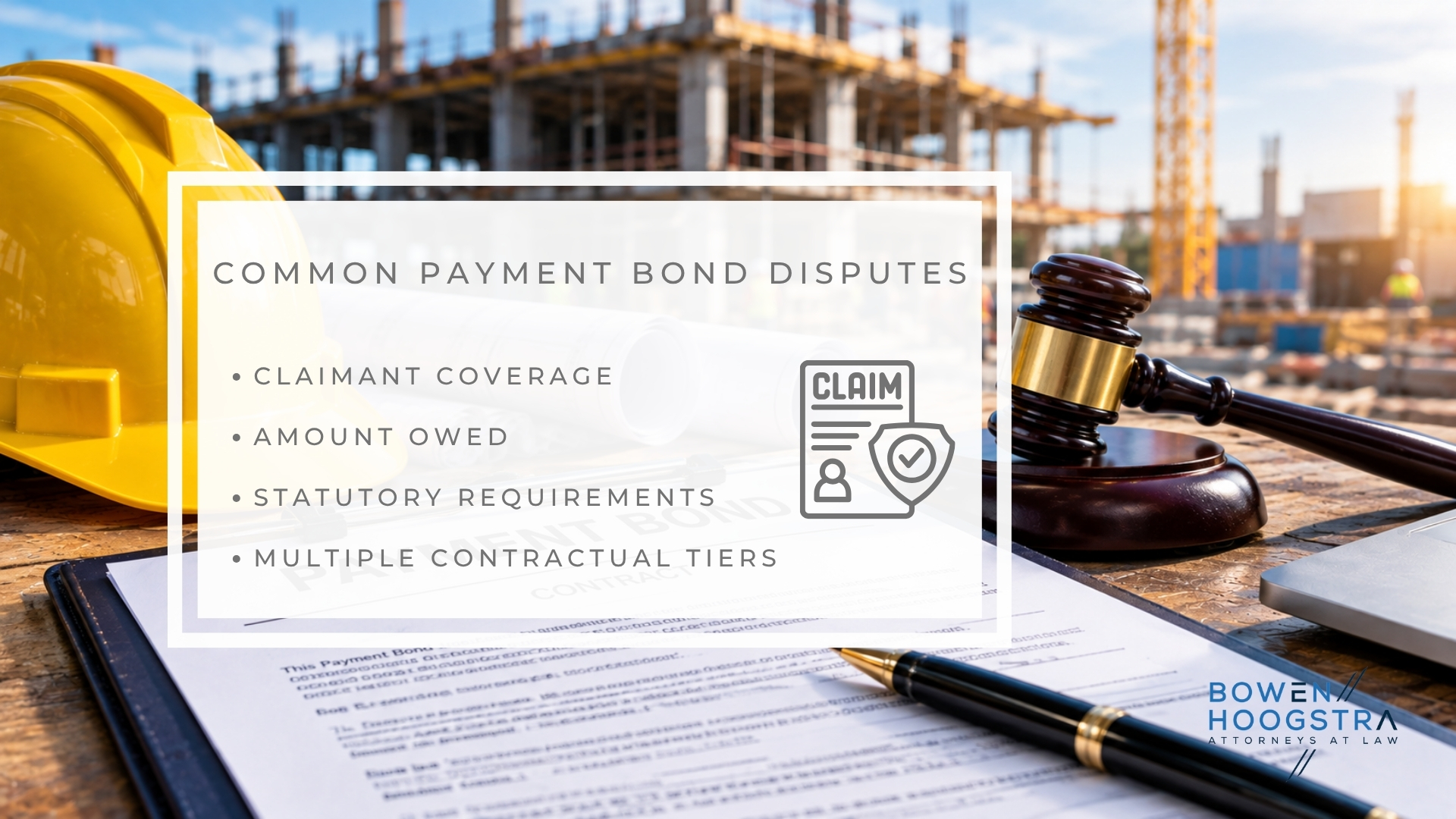
Having a payment bond does not guarantee that every unpaid invoice will be paid automatically. The surety might investigate the claim and raise questions about coverage, the amount owed, compliance with notice requirements, or the position of the claimant in the contracting chain.
Claimant Coverage
Michigan defines a “claimant” as a person who has furnished labor, material, or both that was used or reasonably required for use in performing the contract. The definition can cover certain services and equipment rentals directly applicable to the contract. However, questions can arise when a claimant is farther down the contracting chain or when the labor, materials, equipment, or services do not clearly fit within the bond coverage. A local Muskegon construction attorney can help review your construction contract, invoices, delivery records, and the actual bond language to determine whether you have a valid claim.
Amount Owed
Even when there is no dispute that you worked on the project, the parties might disagree about how much remains unpaid. A contractor or surety might point to defective work, incomplete performance, back charges, change-order disagreements, disputed quantities, or other contractual issues as reasons to reduce or deny the amount claimed. Make sure to keep complete records throughout the project. Signed change orders, daily reports, invoices, delivery tickets, photographs, correspondence, payment applications, and records showing completed work can help establish what you provided and the amount that remains due.
Statutory Requirements
Payment bond claims can involve strict notice and filing requirements. A claimant without a direct contractual relationship with the principal contractor must provide written notice to the principal contractor within 30 days after first furnishing labor or materials. Moreover, the claimant must provide written notice to the principal contractor and governmental unit within 90 days after the last labor was performed or material was supplied for the claim. The notice must contain specified information and follow statutory service requirements. Michigan imposes a limitation period for filing an action on a statutory payment bond, so waiting too long after a payment problem arises can put your rights at risk.
Multiple Contractual Tiers
Payment disputes can become more complicated when several tiers separate the unpaid party from the principal contractor. For instance, a supplier might have contracted with a subcontractor that was itself hired by another subcontractor. The principal contractor or surety might have had little to no direct contact with the lower-tier party before a claim arises. The Michigan notice requirements are designed, in part, to bridge that gap and inform the principal contractor about parties further down the contracting chain. Clear documentation of who hired you, what you supplied, where the work or materials went, and what payments you received can help clarify your position if a bond claim becomes necessary.
Protecting Your Right to Payment on a Michigan Construction Project
Bowen Hoogstra Law can evaluate the circumstances surrounding your construction payment dispute and determine what options might be available. Our competent Muskegon construction attorneys can review your bond documents and contracts, assess whether notice and filing requirements have been satisfied, communicate with contractors and sureties, and pursue an appropriate payment bond claim when necessary. If you provided labor or materials for a Michigan construction project and have not been paid, contact us today at (231) 726-4484 or here to discuss your situation. Let us help protect your right to payment.