Buying a business can be a major step toward growth, independence, or long-term investment. But even a promising deal can become a costly problem if the seller gives you false information before closing. In Michigan business sales, buyers often rely on financial statements, customer lists, inventory reports, equipment disclosures, lease terms, vendor contracts, and other details provided by the seller. When those statements are not true, the buyer might later discover that the business is worth far less than expected.
- What Qualifies as Fraudulent Misrepresentation in Michigan
- The Legal Elements Buyers Must Prove in Court
- Evidence That Strengthens a Fraud Claim
- Protecting Yourself Before and After a Business Purchase
However, not every wrong statement automatically amounts to fraud. A seller might make an honest mistake, give an opinion, or make a prediction that does not come true. Fraudulent misrepresentation is different as it involves a false statement of a material fact made knowingly or recklessly, with the intent that you rely on it, and proving that is not always simple. As the buyer, you must present compelling evidence that the seller misrepresented something significant before or during the transaction.
Let our qualified Muskegon lawyer elaborate on what qualifies as fraudulent misrepresentation in a Michigan business sale and the evidence you need to prove your claim.
What Qualifies as Fraudulent Misrepresentation in Michigan
Fraudulent misrepresentation in a Michigan business sale generally involves a false statement of a material fact. A “material” fact is something important enough to influence the decision of the buyer. For example, a seller might claim that the business has steady revenue, no unpaid tax liabilities, or fully owned equipment when, in fact, those are not true. These are details that can affect the purchase price, financing, future operations, and whether you would have bought the business at all. However, not every sales statement counts as fraud. General opinions, sales talk, predictions, or hopes about future performance are often treated differently from false statements about existing facts.
Note that fraudulent misrepresentation is not the same as negligent misrepresentation. Fraud requires proof that the seller knew the statement was false or made it recklessly without knowing whether it was true. Moreover, the buyer must show reliance and damages. In other words, you must prove that you relied on the false statement when moving forward with the deal and that the misrepresentation caused financial harm. On the other hand, negligent misrepresentation involves justifiable reliance on information, to the detriment of the buyer, supplied without reasonable care by the seller who owed the buyer a duty of care.
The Legal Elements Buyers Must Prove in Court
To succeed in a fraudulent misrepresentation claim, a buyer must prove several connected elements. Each element matters because Muskegon courts won’t treat a failed business deal as fraud unless the facts support your claim. These elements include:
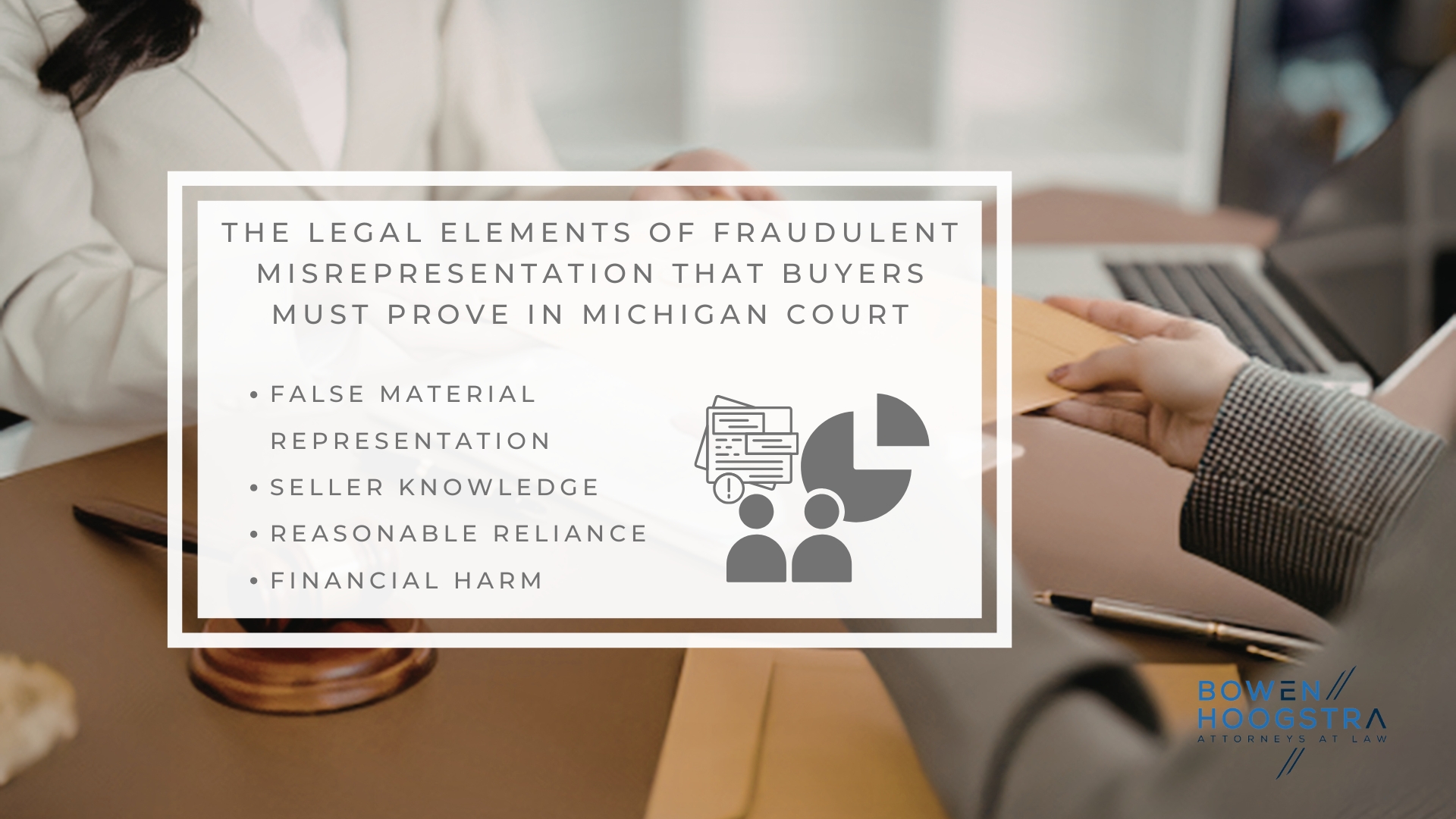
- False Material Representation
The buyer must show that the seller made a material misrepresentation, meaning the seller made a statement about an important fact that was not true. In a business sale, that might involve false information about revenue, profit margins, inventory, licenses, employee obligations, pending litigation, debt, tax exposure, or customer contracts. If the false statement had affected the decision of the buyer, the price, or the terms, it might support a solid fraud claim.
- Seller Knowledge
The buyer must prove that the seller knew the statement was false or made it recklessly without knowing whether it was true. Evidence might come from emails, internal records, prior financial reports, customer notices, communications with accountants, or other relevant business documents. For instance, if the seller claimed that a major customer was still active but had already received a termination notice, that could help show knowledge or reckless disregard.
- Reasonable Reliance
The buyer must show reasonable reliance on the statement of the seller, meaning the false statement must have influenced the decision of the buyer to complete the purchase or agree to certain terms. However, buyers should remember that reasonable reliance can be challenged. If the buyer failed to review available documents or agreed to contract language that directly conflicts with the alleged statement, the seller might argue that reliance was not reasonable.
- Financial Harm
The buyer must prove that financial harm directly resulted from the misrepresentation. It’s not enough to show that the seller lied—you must connect the false statement to a measurable loss. For example, if you paid more for the business because the seller overstated revenue, your damages might relate to the difference between the represented value and the actual value. If the seller hid unpaid obligations, damages might include the cost of satisfying those debts.
A fraudulent misrepresentation claim is strongest when the buyer can clearly connect the false statement to the financial loss. A local Muskegon lawyer can help you organize the facts, preserve evidence, and determine whether your claim has enough support to move forward.
Evidence That Strengthens a Fraud Claim
A fraudulent misrepresentation claim depends heavily on evidence. Even if you strongly believe the seller misled you, Michigan courts often look for documents, communications, records, and testimony that connect the false statements to your decision to buy the business. The stronger your evidence, the easier it becomes to show what was represented, why it was false, how you relied on it, and how it caused financial harm.
Sale Documents
Purchase agreements and disclosure schedules might contain formal representations about the business, including statements about assets, debts, contracts, taxes, employees, licenses, inventory, financial condition, and pending legal issues. If the seller promised that certain facts were true, and those facts later turned out to be false, the written agreement can help support your claim. For example, a seller might represent that there are no pending civil lawsuits. If a lawsuit existed but was not disclosed, that omission might become critical evidence.
Communications
Emails, text messages, letters, meeting notes, and other communications might show what the seller told you before closing, what questions you asked, how the seller responded, and whether the seller avoided certain questions, gave incomplete answers, or made statements that conflict with later-discovered facts. Due diligence documents can be just as useful. If you requested revenue reports, business contracts, vendor agreements, payroll records, tax documents, or lease information, those records can show what information was provided during the transaction.
Financial Records
Financial records include profit and loss statements, balance sheets, tax returns, bank statements, sales reports, accounts receivable records, payroll summaries, and inventory lists. If the seller overstated revenue, hid debt, inflated customer demand, or concealed expenses, these records might reveal the difference between what was promised and what was true. Third-party audits, accounting reviews, and professional financial reports can make the claim stronger. An independent review might show that the numbers did not match the actual condition of the business.
Expert Testimony
Expert testimony can be helpful when the fraud claim involves business value, lost profits, accounting issues, or damages. An expert can explain how the misrepresentation affected the purchase price, future earnings, or value of the business. Their testimony can strengthen your claim because courts often require more than a statement that you “lost money”—you need a clear way to measure that financial impact. If you bought a business based on false revenue figures, for example, a valuation expert can compare the price you paid with what the business was actually worth.
Protecting Yourself Before and After a Business Purchase
The best way to reduce the risk of fraudulent misrepresentation is to verify information before you close the deal. Do not rely only on verbal promises or general assurances. Review financial statements, tax records, customer contracts, leases, vendor agreements, employee obligations, equipment lists, and debt records. If something seems unclear, ask follow-up questions, request supporting documents, and keep a written record of the answers. Careful due diligence can help you avoid buying a business based on incomplete or misleading information.
Bowen Hoogstra Law understands how business disputes can affect your finances, operations, and future plans. Our competent Muskegon lawyers can evaluate the transaction, review the purchase agreement, identify key evidence, and determine the best path forward. If you believe you were misled during a business purchase or if you are facing allegations of fraudulent misrepresentation, contact us today at (231) 726-4484 or here to schedule a consultation. Let us help you protect your rights, assess your options, and take the next step with confidence.