Real estate transactions can fall apart for many reasons. A buyer might be ready to close, only to learn that the seller no longer wants to move forward. Perhaps the seller changes their mind, receives a better offer, or refuses to close for reasons that are not supported by the contract. When that happens, a buyer might wonder, “Can a court force a house sale?” In some Michigan real estate disputes, the answer might be yes. That legal remedy is called specific performance.
- What Specific Performance Means in Real Estate Disputes
- When Michigan Courts May Force a House Sale
- Defenses Against Specific Performance
- Protecting Your Rights in a Michigan Real Estate Dispute
Instead of simply awarding money to the injured party, the court might order the other side to do what the contract requires. In a real estate sale, that can mean ordering the seller to complete the transaction and transfer the property as promised. Let our experienced real estate attorney in Muskegon elaborate on how specific performance works, when Michigan courts might order it, and what buyers and sellers should know before filing a civil lawsuit.
What Specific Performance Means in Real Estate Disputes
Specific performance is a legal remedy where the court orders a party to complete the exact promise made in a contract. In a real estate dispute, that often means a buyer asks the court to require the seller to go through with the property sale. For example, if a seller signs a valid purchase agreement, accepts the offer of the buyer, and later refuses to close without a valid legal reason, the buyer can ask the court to enforce the agreement. Muskegon courts have recognized specific performance in real estate contract disputes because the loss of a specific property might not be fully compensated for by money alone.
Specific performance is different from ordinary breach-of-contract damages. In many contract disputes, the injured party receives money to cover the loss caused by the breach. But in real estate, money might not put the buyer in the same position. The property might have a specific location, size, view, neighborhood, zoning benefit, investment value, or personal importance that cannot be replaced by another house on the market. That’s why a court might look beyond monetary damages and consider whether the most equitable remedy is to require the sale of the property to be completed.
When Michigan Courts May Force a House Sale
Michigan courts do not force every disputed real estate sale to close. Specific performance is generally considered an equitable remedy, meaning the court looks at fairness, the contract stipulations, and the conduct of both parties before deciding whether to order the sale.
Valid Purchase Agreement
Under the Michigan Statute of Frauds, real estate transactions generally must be in writing, and courts typically look for a written agreement signed by the parties when disputes arise. The agreement must show that both sides intended to enter into a binding sale. If the supposed agreement was only a casual conversation or an unsigned draft, specific performance might be difficult to obtain.
Clear Terms
The contract terms must be clear enough for the court to understand what must be enforced. A purchase agreement should identify the property, the purchase price, closing obligations, payment terms, deadlines, and any important conditions. If the terms are too vague, the court might not be able to order specific performance because it cannot rewrite the deal for the parties involved.
Buyer Readiness
A buyer seeking specific performance needs to show readiness, willingness, and ability to perform their own obligations under the agreement. That can include having financing in place, meeting inspection requirements, making the required deposit, satisfying contract deadlines, and being prepared to close. The buyer cannot demand that the seller close while ignoring their own responsibilities.
Seller Refusal
Specific performance can become an issue when the seller refuses to close without a legally valid reason. A seller might regret the sale price or simply change their mind. Those reasons alone might not be enough to avoid a valid contract. That said, not every refusal is wrongful. A seller might have a defense if the buyer breached the agreement, missed deadlines, or did not satisfy contract conditions.
Defenses Against Specific Performance
Not every real estate dispute leads to a court-ordered sale. Even when one party asks for specific performance, the other side might raise defenses to show why the court should not force the real estate sale transaction to move forward. Common defenses include:
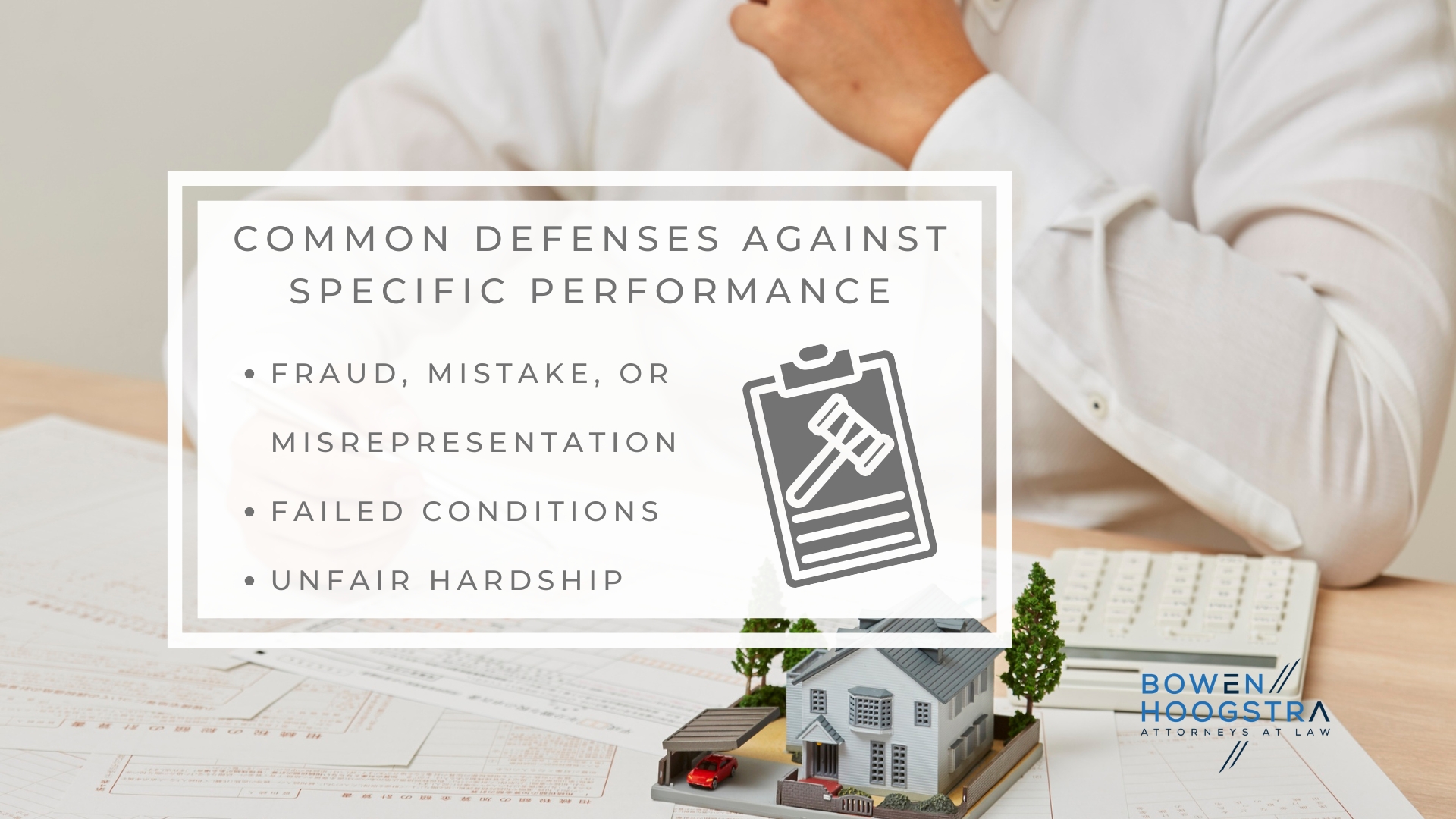
- Fraud, Mistake, or Misrepresentation
Specific performance might be challenged if the transaction involved fraud, mistake, or misrepresentation. If one party was misled about an important fact or given false information that affected the agreement, the court might not enforce the contract as written. The issue is not only whether a real estate contract exists, but whether it would be fair to make the parties complete it.
- Failed Conditions
Courts often evaluate whether the buyer substantially performed their own obligations and whether the buyer was prepared to complete the remaining terms of the deal. If the buyer could not get financing, missed deadlines, failed to pay the required deposit, or did not satisfy inspection or appraisal contingencies, the seller might argue that the buyer is not entitled to force the sale.
- Unfair Hardship
Because specific performance is an equitable remedy, a court might consider whether enforcing the sale would create an unfair hardship. For example, a party might argue that there was bad faith or that the circumstances changed in a way that makes enforcement unreasonable. In simple terms, the court examines whether forcing the sale would do justice based on the full situation.
That’s why both buyers and sellers should get legal representation and guidance before assuming the court would automatically enforce or reject the sale. A local real estate attorney in Muskegon can review the purchase agreement to determine whether specific performance might be available or whether another remedy makes more sense.
Protecting Your Rights in a Michigan Real Estate Dispute
A real estate contract dispute can put your property, money, and future plans at risk. Whether you are a buyer trying to enforce a signed purchase agreement or a seller defending against a demand for specific performance, it’s important to understand your rights before the dispute escalates or the property is sold to someone else. Bowen Hoogstra Law can help you review the purchase agreement, assess the strength of your position, and determine the best path forward.
Our seasoned real estate attorney in Muskegon can explain whether specific performance might apply, whether defenses are available, and what steps you can take to protect your interests. We can help you respond to demand letters, negotiate a resolution, or pursue legal action when necessary. Don’t rely on guesswork when a property transaction is at stake. If you are involved in a Michigan real estate dispute and need clear guidance, contact us today at (231) 726-4484 or here.